Rocky Vale Villa and the Beebes
In 1986 I came to Rocky Vale Villa for the first time to take photographs of the house for Bendigo Historic Buildings, which I was compiling with Gill Flanders. In those days, you could still see the house from the Highway, and many were intrigued by it. Mr Gray allowed me to take some pictures and a decade later I obtained an earlier photo of the front from Adele Casbolt, who had played here as a child. No doubt she told me the date, but I’ve mislaid it.
Today we will look at what we know of the home of William Beebe senior and a little about him and three of his sons who became architects and builders or contractors.
The Beebe name was well-known in Bendigo in the last quarter of the 19th and the early part of the 20th centuries. From 1875, William Beebe senior, monumental mason, occupied a site in the centre on the city, in Mitchell Street opposite King Street. Death was more part of life in those days, and the Beebes were there to provide the burial monuments. Later, he took his sons into the business, which grew as Beebe and Son. Many examples of their work can be found in the local cemeteries.
William Beebe senior (1830-1891) was born in Rutland, the smallest English county in 1830, to stonemason Chamberlain Beebe and Susannah Clements. William emigrated to Victoria in 1854 and after engaging on unknown works in Port Fairy, Dunkeld, and Melbourne arrived in Bendigo. His obituary records that he commenced work here on the site of the Bank of Australasia (opposite the Shamrock Hotel), which would have been no later than 1856. He took up a 13 acre selection on the site of Rocky Vale Villa in 1864 and continued to select or purchase further parcels of adjoining land until he owned some 150 acres, much of it unfit for cultivation. He was a keen gardener and had a garden and orchard around the house.
Jacob and Esau, two of William Beebe senior’s brothers, followed him to Bendigo. Jacob was employed as a driver at Horwood’s foundry where Girton College now stands. He died in 1867, when he fell under a wheel of a heavily loaded truck he was driving. Esau (better known as George) later farmed in the Minto district, north of Bendigo. He died in 1882.
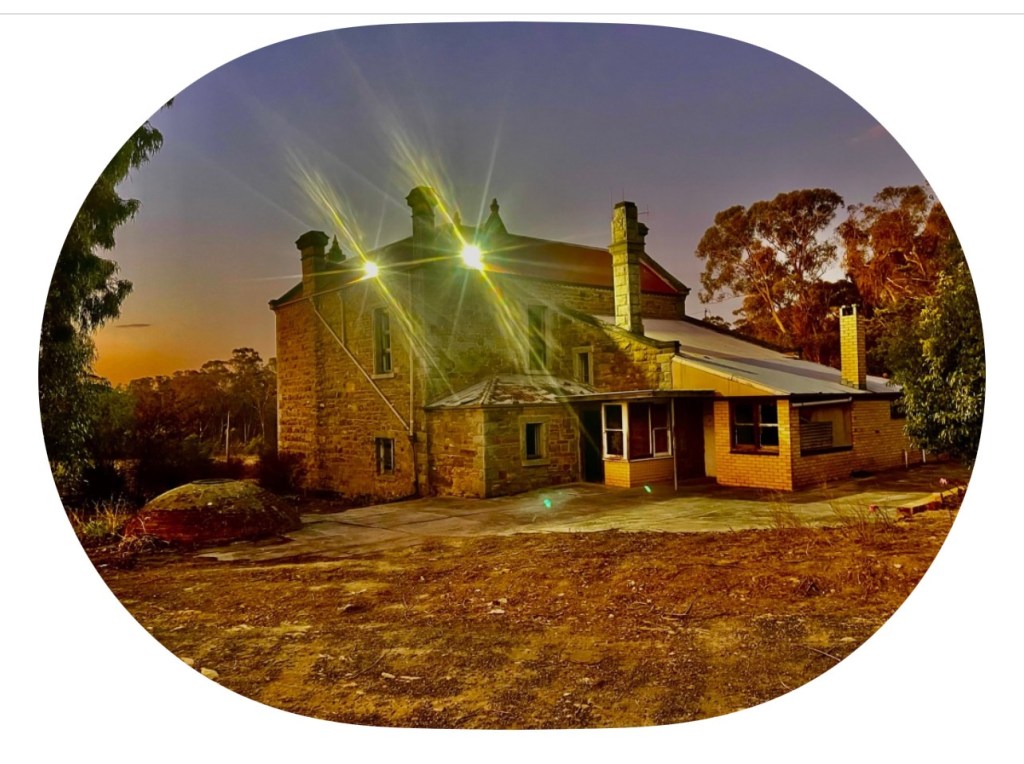
Three months before William Beebe senior died in September 1891, a Bendigo Advertiser journalist visited Rocky Vale Villa, and left us with our only contemporary description. It had taken William 25 years to build the house and out-buildings in the evenings, after work. The Advertiser reported that his house, a ‘large two-storied stone building, peculiar in its structure, as the owner is well-known in his ideas.’ The walls were built from stone quarried on his property, with Harcourt granite quoins, sills and openings. It is an imposing structure. The Advertiser journalist extolled the efforts of the Beebes (husband and wife) as an ideal to be followed by others and ‘a thousand times better than playing football or cricket.’
Architecturally, Rocky Vale Villa is described in the Victorian Heritage Database Report as ‘a rustic Gothic Revival two-storey house built of sandstone and granite, on a ‘L’ shaped plan with an engaged tower at the junction of the two gabled wings.’ It is of local historical and aesthetic/architectural significance.
1It is an intriguing house, originally on split-levels, of which there is ample evidence, although it was later altered to bring the ground floors into alignment, possibly in the 1950s, when the marble fireplaces were replaced. The floors have been removed in recent years, revealing the original design, but it will take some imagination to bring the whole building into functionality. It feels like the work of somebody who had not thought through the whole design before starting to build.
The Advertiser has provided us with almost all that we know about William Beebe, because they published his letters on a range of social and other issues. He was an atheist, secularist and anti-monarchist who specified in his will that he should be buried without a religious service in a section of the cemetery set aside for people of such beliefs. It is a small section, but it serves as a reminder that not all in the community were from the conventional Christian denominations or other major religions. As a philosophy, secularism seeks to interpret life based on principles derived solely from the material world, without recourse to religion.
William Beebe senior claimed to have had no schooling until he was in his twenties, but judging from the letters he wrote to the Bendigo Advertiser, he was quite literate as well as a man of firm views. He is not known to have had any training in architectural drawing, whereas two of his children, William junior and John, both became architects, although they were probably too young to have contributed anything to the design of Rocky Vale Villa.
William Beebe senior was a follower of Charles Bradlaugh, a Victorian Atheist, orator, free-thinker, agitator and reformer. Beebe presented a copy of a book of Bradlaugh’s speeches to the School of Mines library, where it is now part of the historic Sandhurst collection.
Bradlaugh was famous for forcing the establishment to change the law to allow non-believers to take their place in the British parliament. Many of William Beebe’s arguments are well made with supporting evidence not then readily available. He objected to the local council spending money in celebration of Queen Victoria’s jubilee in 1887 and other letters concerned Bendigo’s water supply, the sale and nationalisation of public lands and other issues as they arose.
William Beebe’s burial service was carried out in accordance with his will: an old friend, WDC Denovan, the Town Clerk and a known Spiritualist made some apposite remarks at the graveside. Surprisingly, he described Mr Beebe senior as a ‘kind affectionate father’, but this was unlikely in view of his evident partiality for his eldest son, William junior. Most of the family were entirely excluded from his will. William senior and William junior, already in a partnership as masons and contractors, advertised as architects from May 1887. Possibly William senior was responsible for the building supervision, while his son made the drawings.
William Beebe junior (1857-1920), grew up in the shadow of architect William Vahland, but from the outset William junior was successful and became the dominant architect locally within a few years. Many, if not most, of his buildings have survived and are now highly sought after. Some, such as the ANA Hall, which once stood on the site of the Bendigo Art Gallery were lost before their heritage value was recognised in the 1970s. After his father’s death in 1891, William Beebe was in sole practice until he took George Dawson Garvin into partnership in 1907.
In contrast to his father, William Beebe junior gained a prominent place in the public life of Bendigo, sitting on many boards and committees. He was energetic and able. In local government he was elected unopposed in 1913 and quickly rose, so that during the demanding years of WW1 he was unanimously chosen as mayor in two successive years.
During the second term he suffered a debilitating heart attack and he died in 1920. Two of his daughters died young from typhoid and his two remaining daughters married and moved away from Bendigo. William Beebe’s response to the deaths of his two daughters to typhoid fever was to advance the sewerage system of the city to reduce the prevalence of such epidemic diseases. Any hopes he had for a son to continue his business died with his eldest son at the age of 14 years in 1894. William’s surviving son, Wilfred John Beebe (1885-1937), had some training under his father, was said to be unwilling to work with George Garvin.
Wilfred married a Queenslander where his family thrived. He lacked the talents of his successful father, but was reportedly a better father. William provided for Wilfred in his will, but under the strictest conditions, including that he must conduct himself in a ‘proper and sober and industrious manner.’ It sounds as though they had had a troubled relationship.
William Beebe junior was fascinated by cars and could afford to indulge his hobby. News cuttings from various sources have survived with the family to testify to his early excursions,
including hints from him about improvements he invented. He passed this passion to his daughter, Flora Woodman Beebe, who was the first woman in Bendigo to hold a driver’s license in 1911.
John Beebe (1866-1936) had worked with his father as a stonemason, and later joined with Jonathan Mayne, also in Mitchell Street as monumental masons. Then in 1900, John Beebe advertised his services as an architect. The timing cannot have been coincidental, because William junior was just leaving for a tour in Europe. It was a difficult time to begin such a practice, when many architects were still out of work because of the general depression in the 1890s. His acceptance of the offer to take the place of William Vahland in the existing partnership between William Vahland and his son Henry, offered John the career boost he needed. John was then in direct competition with his brother for commissions. However, Henry Vahland’s death in 1902, caused William Vahland to return from retirement, but it is unclear what role Vahland had from then on. Some light was thrown on this by a court case in which Henry’s widow sought restitution for lost income from the partnership. It suggests that John Beebe had the leading role in the partnership, although Vahland was the public face.
The partnership with Vahland ended in 1909, leaving John Beebe in sole practice until his departure for Queensland in 1916. The talented architect Eric Trewern served his articles under John Beebe and both he and John Beebe obtained employment with the Department of Public Works in Brisbane from 1916. John’s wife disliked the Queensland climate and returned to live with family in Hampton. Several buildings can be attributed to John Beebe in Brisbane, including the Art Deco portals of the Hornibrook Highway. John left a very modest estate and lies in an unmarked grave in Lutwyche Cemetery. One of his executors was Sir Manuel Hornibrook, to whom he left his technical books in his will. He never attained the success as an architect that his brother enjoyed, but he was probably more studious and reflective than William. John was a mathematician and interested in astronomy, he built an observatory in Condon Street,
Bendigo, in 1900, which still stands and has been the subject of intense interest in relation to the history of astronomy in Victoria. His involvement with astronomy in Queensland was more extensive and has been written about by astronomers Peter Anderson and Wayne Orchison. Of his four children, only Ella, his youngest daughter, remained in Bendigo, marrying William Bolton in 1921.
James Beebe (1866-1923), another of William Beebe junior’s brothers, left Melbourne for South Africa at the end of the 19th century. He went with his wife, Christina Munro from Castlemaine and their son, Eric, born in Albert Park. Both died in the Eastern Cape town of Graaff Reinet. Christina died and1898 and with young Eric to look after, James married again, to widow Ellen Mary Connor. She was pregnant with their first child, Reginald, in 1902, when Eric died aged just six years. It is comforting that Eric was mothered by Ellen through his short life. Reginald grew to marry and have children of his own, but his sister, Mary Kathleen, remained with the convent where they were raised and became a nun. In an amazing coincidence, Wilfred Beebe’s son, Grantley, was in practice as a dentist in South Africa, when he treated a nun named Mary Kathleen Beebe. They guessed that they must be related, but did not know that Mary Kathleen was James’s daughter. James Beebe died in Lourenzo Marques, Mozambique in 1923. Nothing is known of the work as a contractor carried out by James, nor of the possibilities of finding any relevant records in South Africa.
Other architects from Australia, such as WH Chandler from Bendigo, also tried their luck in South Africa in the 1890s and it remains a subject for future study.
The significance of Rocky Vale Villa in the local context is included in the Victorian Heritage Register citation, but until the future of the house is physically secured and the ravages repaired, there is a danger that it will be lost.
Source: https://www.nationaltrust.org.au/wp-content/uploads/2024/06/Rocky-Vale-Villa-and-the-Beebes.pdf
 Rocky Vale Villa Spring Ball